Synopsis:
Arun Avira, an NRI living in the US, goes to India to sort out issues concerning his ancestral property in the rugged hilly village of Karimala in Kerala. Arun’s property was entrusted with Chacko, a trustworthy man, after the death of Arun’s father.
Today:
The meandering road climbs a steep hill and enters Karimala Rubber Plantation. The road cuts across the bottom of Chempankunnu, a craggy stretch of hill mostly blanketed by rubber trees. There’s just about another kilometer of road that is passable by car. New plantings of rubber have replaced old trees that were felled a year ago. Rubber wood hardly fetched any money when I was a kid growing up in the village. As teak, rosewood, anjili, and other hardwood trees have become almost extinct in Kerala, processed rubber wood has become a prized commodity for the manufacture of furniture and other products.
Laborers clearing weed among the rubber saplings stopped work upon hearing the approaching rumble of my jeep and stared curiously at the vehicle and its occupant. Only visitors from far or the owner of the plantation came to Karimala in a vehicle. Others usually walked to Paloorvalley, the nearest town, to get a bus. Before the buses were introduced to the town most people went over the hill to Peruvanthanam, another town nearby, to catch buses.
So much has changed. The dirt road has given way to asphalt. In those days the potholes and bumps were so familiar for me, I could walk on the road blindfolded.
The road leading to the house ends abruptly where a narrow dirt road meets it and skirts around a smokehouse and storeroom towards the Karimala River. Behind the structure there is a layam, the living quarters for workers of the rubber plantation. One has to cross the river on foot or by jeep to reach my house on the other side. Though I could have avoided getting wet by taking the new bridge, I chose to drive through the shallow river. To my surprise the jeep stopped short of the river with a flat tire.
Will look into that later, I thought.
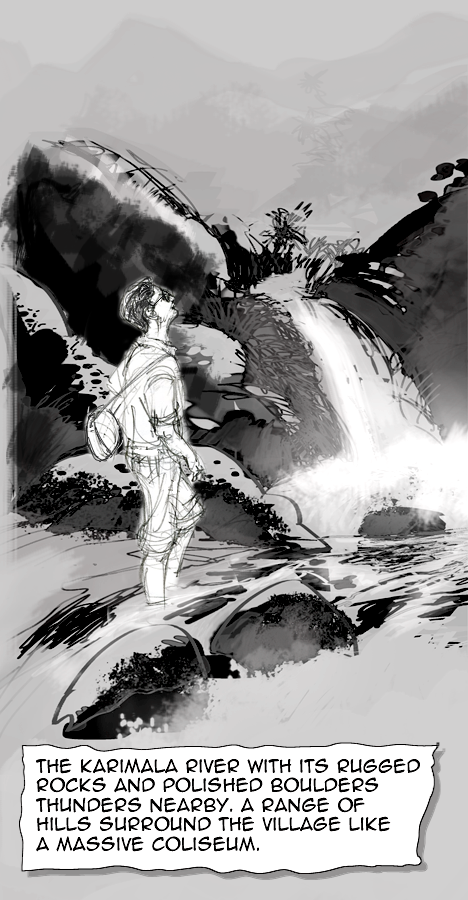
I got out of the vehicle and walked into the water. I stood in the middle of the river and enjoyed the flow of clear, cold water around my feet. A tall mango tree that has seen many summers stood by the river bank; the sole remnant of a forest that has long gone and gave way to a rubber plantation. The tree’s reflection created ghostly figures in a pool of water under it. A few wild beehives were hanging under its branches as always. The strong current in the river brought with it memories twenty summers old.
I was studying in a college at a quiet hamlet by the backwaters of Cochin. Christmas exams ended by noon on a Thursday and most hostelers were busy packing their bags to go home. Though I had planned to go on Friday, I changed my mind and decided to leave on Thursday itself as there were a couple of friends going to Kottayam by the 2:00 PM Thekkady Express bus. If I got that bus I would be home by 6:30 PM. If I didn’t get it, I would have to wait for a later bus or trainto Kottayam and would have to stay with my friend Abraham and then leave by bus in the morning. This was, however, the option I least preferred.
There was heavy rush for the Thekkady Express. All the seats were taken by a horde of pilgrims who were on their way to Sabarimala, a temple devoted to the Hindu deity Dharma Shasta (Aiyyappa), in the thick jungles by the river, Pampa. Sabarimala attracts millions of pilgrims from all parts of India and beyond for Makara Vilakku in January. I managed to squeeze through the rear door and found myself dangling from a handrail among other daring travelers and devotees. I cursed myself for making the hasty decision to go with my friends. It was almost 2:00 PM. I had to decide fast: either break the journey or hang on and make the trip.
I decided to hang on.
Express buses normally carried only a limited number of standees. But it was the season of Sabarimala pilgrims; special occasions called for special measures. The ride to Kottayam was an adventure of its own.
I struggled hard to hold on to whatever I could grab on to keep my feet in contact with the deck below. The zigzagging road made the journey a tiring, backbreaking experience.
Luckily I found a little spot of seat among the pilgrims as the bus reached Kottayam. It was almost 4:15 PM. I felt relieved in the knowledge that in another two hours I would be ending the journey. Then it was only a matter of 20 minutes of walking to my house.
The bus moved slowly out of the bus station and hit the Kottayam-Kumili Road. Despite the bumpy ride, the thought of reaching home before sundown comforted me. Time ticked away; minutes seemed like hours. I was now more concerned about reaching home before night. The thought of walking alone through the rubber plantation at night gave me jitters.
The bus pulled into Ponkunnam, a sleepy junction where peddlers haggled and competed with beggars for a pittance. The bus appeared stalled. Time ticked by. Passengers became impatient as the driver didn’t make any move for the onward journey. Some went out to investigate.
“This bus is not going anywhere!” someone shouted from outside. Passengers became agitated and wanted to have their money refunded. The Aiyyappa devotees joined the din with their loud ‘Aiyappo-swamiye’ chants. What to do? I got out and bought a soda and a pack of Wills Flake from a nearby shop.
“Get me two candles and a match box too,” I told the vendor.
“Engotta?” (Where to?”) asked the shopkeeper as I readied for the uncertain night ahead.
“Peruvantham,” I replied while lighting a cigarette.
“Kondody for Upputhara should be here soon,” shopkeeper said as he handed over my purchase and some change.
The wait for Kondody seemed like an endless vigil. As cars and chartered buses passed by, my hope for reaching home before night died with the setting sun. Lo! An overloaded Kondody pulled into the bus station and started emptying its contents onto KK Road.
Suddenly there was a scramble for seats. People swarmed both the doors and getting inside seemed like a lost cause. I had to get in somehow.
I gave my handbag to a passenger sitting by a window and asked him to save a seat for me. He gladly obliged.
“Engotta?” My benefactor wanted to know.
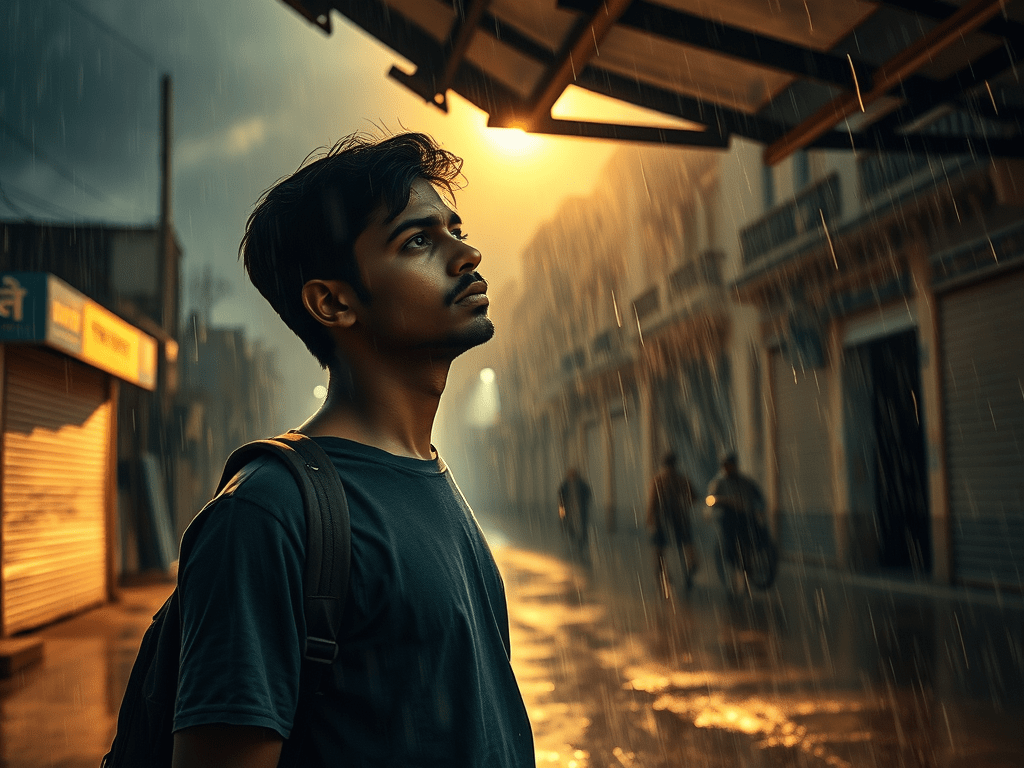
It was around 8:00 PM when I got down at Peruvantham. The road appeared deserted under a dim street light in the distance. I took out a candle and lit it. Keeping the flame alive in a stiff wind that was whipping through the sleepy hills was a struggle. I felt cold and scared.
The old dirt road I had to take ran through a rubber plantation for about half a mile. From there a narrow path went down the hill and across the Karimala River. I cupped my palm and held the candle between my fingers to shield it from the unruly wind. The path ahead became clear as I held the candle on my side. However carefully I shielded the candle from the wind it kept blowing out. I felt an uneasy fear overpowering me. Except for the flickering glow of some fireflies and the nagging wind the night was eerily quiet. I had used up almost all the match sticks in the box. Then I picked up a coconut shell off a rubber tree and used it to shield the candle from the pestering wind. It also worked as a reflector and threw more light on the path. Now I could see the road ahead quite clearly. When I thought I was finally safe from the wind, the candle died out mysteriously even when there was no wind! I became really scared. I could hardly see the road ahead. Then I saw something moving in the distance.
I saw the shape of a man walking ahead of me. I wondered who the daredevil be that ventured to walk in pitch darkness! The figure stopped walking and turned to face me. I recognized the man as I went closer. It was Bhaskaran, the man who tapped rubber trees in our plantation. I felt very relieved to see Bhaskaran because now I had someone to accompany me to my house. Since he was mute, our communication ended with a few courteous gestures. He offered to light the candle for me and lit it without a problem. He was a godsend, I thought. The candle didn’t blow out again. Bhaskaran walked behind me and bid goodbye as we crossed the Karimala River.
My parents were surprised to see me. They weren’t expecting me at all. Especially at night. They wondered why I didn’t travel as planned. The villagers rarely went anywhere at night for fear of confronting wild animals, snakes, or even evil spirits.
While having supper I told my parents why I was late and how fortunate I was to get Bhaskaran to accompany me all the way home.
“Bhaskaran, who?” inquired my mother.
“The guy who taps our rubber trees, Amma! Who else?” I replied with a bit of annoyance.
“OK. We’ll talk about it and more tomorrow,” my father interrupted. “You need rest. Good night.”
It was past 8O’clock in the morning when I got up.
I badly needed a smoke. I grabbed my Wills Flake and match box; walked down the path through the rubber plantation towards Karimala River. On the way I saw some old hands tapping the rubber trees but didn’t see Bhaskaran.
“Where’s Bhaskaran?” I asked Gopalan.
Gopalan looked up towards the sky.
“Didn’t Amma tell you?” he exclaimed.
“No, what happened?” I demanded.
Gopalan didn’t answer me immediately. He gestured for a cigarette. His hands were shaky and fumbled with the cigarette. He took a deep drag and cleared his throat. He looked sad and angry. Finally Gopalan regained his composure and started talking slowly.
“Three days ago Bhaskaran climbed that big mango tree by the river to collect wild honey. The bees stung him so badly the poor man lost his grip and fell. I told him it was a bad idea. He didn’t listen. Maybe his time was up!” Gopalan went on talking like a mad man.
I choked on the cigarette in disbelief! If Bhaskaran was dead and what I saw last night was his ghost, then who was alive and who was real? Was Gopalan real? I didn’t want to know. I returned home as fast as I could.
“Don’t want to get out of the water, eh?” I looked around in astonishment. Standing behind me was Varkey, an old man from the neighborhood. He looked tired and pale. Except for a faded scapular and a few gray hairs, his chest was bare and flat. He was wearing a dirty checkered lungi that hasn’t seen water for a while. An equally dirty handloom towel was hanging over his shoulder. I guessed he was at the river to give himself a thorough wash.
“I saw the jeep; knew it was you,” he giggled. Two stained incisors popped out of his wizened mouth. A true copy of Pop-eye.
It appeared that there was no one at my house. Chacko, the caretaker, should have come out if he were there. It’s rumored that he was goofing around.
“I will go with you up to your house. When are we going to meet like this again,” Varkey said as if he was not expecting to see me any time sooner and wanted something from me.
“Let go off the bag, I’ll carry it,” Varkey yanked the airbag from my shoulder.
“No, no, don’t. You’re an old man with a bad heart,” I tried to discourage him. It didn’t work.
Varkey kept pestering me with questions of all sorts as we walked up towards the house. He wanted to know among other things, were there crows and mosquitos in America, why did I come alone; my job, salary, and most importantly, was there any liquor bottle inside the bag!
Even before we reached the house a dog was heard barking and howling as if it has seen something strange. The dog moved away as we entered the courtyard but continued to howl from a distance.
There was no one in the house. Though I arrived without letting anyone know about it, I was expecting to see someone there. Now I have to wait for Chacko. I sat down at the edge of the veranda and glanced around. The house was in disrepair. Even the courtyard appeared to have got any sweeping for a long time.
“I will go find him. He could be sitting somewhere in town and playing cards,” Varkey offered help.
“OK. Do it fast… I’ve to leave soon… Don’t join him!” I tried to make him understand my urgency.
“I need some money. Doctor told me there’s fluid in the lungs. The money you gave me last time helped a lot,” Varkey pleaded as he moved his hand back and forth over his chest.
I was at wits end. This man was sick and badly needed care. There was just enough rupees with me for incidental expenses.
“Need not be in rupees; dollar is fine,” Varkey suggested an alternative as if dollar was the standard tender in Kerala.
“Here’s one thousand rupees,” I took out a twenty dollar bill from my wallet and gave Varkey.
“I’ll never forget this. God will provide,” he walked away in search of Chacko.
The dog that yelped and howled around the house came back wagging its tail. It was Kaiser. He hadn’t forgotten me even after two years. He came closer and settled down in front of me and focused his attention on my face. Time ticked by.
The horn from a truck across the hill jolted me up as though from a slumber. I glanced at my watch. It was past two. There was no sign of either Varkey or Chacko.
Kaiser raised his head and looked towards the road. He has sensed that someone was approaching the house. It was Chacko. The dog jumped up and down happily around Chacko.
“I saw the jeep from the grocery shop but didn’t know it was sar (Sir) until Kandathil Kochu told me.”
Chacko put down a sack of grocery that he was carrying on his head. He took out a key and opened the front door.
“There is no current,” Chacko mumbled from the kitchen to let me know that there was no electricity in the house. Supply of electricity is very erratic in remote places like Karimala, especially in rainy season.
“Take a seat sar,” Chacko dusted a chair for me to sit. “You must be tired. I will make some coffee for you,” said Chacko as he went back into the kitchen with the sack.
“I had sent Varkey to look for you. Where’s he?” I inquired.
Chacko ran out of the kitchen like a devil that saw the cross.
“What’s the matter?” I didn’t get it.
“You…you too saw him? When I was coming… I think I saw Varkey… he… he was there…at the river.” Chacko started shaking like a wet dog.
“It was his funeral…yesterday…cancer…in his lungs…,” Chacko struggled for words.

 The Brew
Leave a comment