I woke up from an unusual dream: I was at a publisher’s gallery celebrating the release of my illustrated story book. The illustrations caught the eyes of many who gathered there. Most of them were book buffs but there was someone who was there for something else. Who knows what? Now read the story and find out.
As the gallery’s yellow lights cast a warm glow over the gathered crowd, my new illustrated book lay on the display table, its glossy cover catching every flicker of the chandeliers. I had poured years into those 200+ pages of the book — sketches born in midnight hours, colors layered with precision and care.
The guests took to it instantly. The book moved through the room from hand to eager hand. I watched its journey: a professor bending close to inspect the ink lines, a young girl tracing her finger over the painted sky, a man in a grey suit flipping the pages quickly, as though searching for something.
An hour later, it returned to me. At least, part of it did. A few pages were missing, ripped cleanly off from its sewn binding with precision.
A strange unease settled over me. Those missing pages weren’t random. I knew exactly what was on them — three illustrations that, when placed together, formed an image I had never intended anyone to see. An image that wasn’t part of my original plan.
The first was a charcoal sketch of an abandoned clock tower in the mist. The second, a watercolor of a narrow alley with red symbols scrawled on the walls. The third, an acrylic rendering of a black door with no handle.
Separately, they were harmless. Together, they formed something I’d never drawn consciously — a map.
I scanned the crowd. The man in the grey suit was gone.
That’s when I noticed something else. On the display table where the book had first rested, there was now a folded scrap of paper. With no name or greeting, a single line was written in tight, deliberate handwriting:
“If you want the missing pages, meet me at the clock tower at midnight today.”
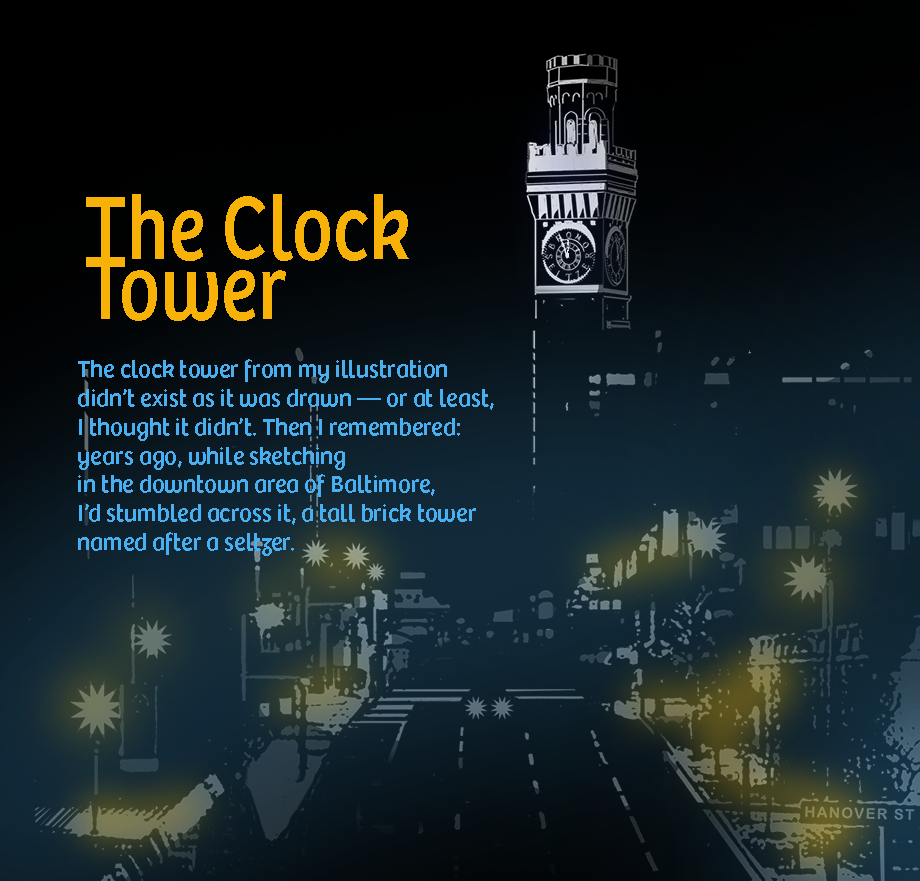
The clock tower from my illustration didn’t exist as it was drawn — or at least, I thought it didn’t. Then I remembered: years ago, while sketching in the downtown area of Baltimore, I’d stumbled across it, a tall brick tower named after a seltzer.
The city was almost unrecognizable at night. Streetlights buzzed faintly, their halos dissolving into the fog rolling in from the harbor. I walked with my collar turned up, the folded note warm in my pocket.
It was five minutes to midnight when I reached the tower. I waited, scanning the dark windows of the structure. Then footsteps echoed behind me.
I turned around slowly.
It wasn’t the man in the grey suit I was waiting for. This one was an younger guy, with a messenger bag slung over his shoulder and a cautious look in his eyes.
“You’re the artist, right?”
I didn’t reply. I waited for him to talk.
“Good. That means you don’t know.”
“Know what?” I didn’t understand what he was talking about.
He opened the bag just enough for me to see the corner of a page — my page — folded between old, yellowing documents.
“The man who took the other two pages works for someone dangerous,” he said. “Those illustrations aren’t just art. They match a set of blueprints that went missing from the city archives twenty years ago.”
My pulse quickened. “Blueprints to what?”
He glanced up at the dark tower.
“To what’s under this place.”
We slipped around the base of the clock tower to a section of brickwork etched with faint scratches — the same red symbols from my second missing illustration. He pressed one brick, and with a groan, a slab of wall swung inward.
Cold air rushed out, smelling of damp earth and rust.
We descended a narrow staircase into a chamber dominated by a vast metal door embedded in concrete.
“This is what they’re after,” he said. “A Cold War-era vault. It was never listed in public records. Whatever’s inside… it was meant to be forgotten.”
The black, handleless surface of the door was identical to my third illustration.
“How could I have drawn all of this if I didn’t know it existed?” I asked.
“That’s what I was hoping you could tell me.”
A metallic clang echoed from above — the sound of the brick door being forced open. Voices followed, low and urgent.
“They’re here,” he whispered.
He shoved the flashlight into my hand and reached into his bag, pulling out the page I’d seen earlier. “If we split the pages, they can’t complete the map. Go. Take this and find a way out through the service tunnel. I’ll hold them off.”
Before I could protest, he pushed me toward a narrow passage branching off the chamber. I turned back once to see him place the other documents on the floor and draw something from inside his coat — a compact pistol, matte black.
Then I ran.
The service tunnel was narrow, the air thick with dust and the metallic tang of old pipes. My footsteps echoed, so I slowed. Faintly, I heard shouts — then two sharp cracks. Gunshots. Then silence.
I kept moving until the tunnel opened into a forgotten maintenance room. A corroded ladder led up to a steel grate. I pushed it aside and climbed out into the cool night air of an alley two blocks from the harbor.
Only then did I look closely at the page in my hand. It wasn’t just the alley illustration I’d painted — there were markings I’d never made: faint pencil lines tracing a route from the clock tower to a location across the city. At the bottom, scrawled in the same handwriting as the note from the hall, was a single word:
“Keep.”
I didn’t know if the young man was still alive. I didn’t know what lay inside that vault, or why my drawings matched places I’d barely seen. But I knew one thing: whoever wanted these pages wasn’t done looking for them.
And now, they’d be looking for me.
I folded the page carefully, slipped it into my jacket, and stepped out of the alley into the sleeping city. Somewhere out there, the rest of my book was in someone else’s hands — and the only way to get it back was to follow the map I’d unknowingly drawn.
The game had just begun.


 The Brew
Leave a comment